The FCC Ruling and the Rise of Open, Controllable WiFi Infrastructure
WiFi infrastructure is no longer just about connectivity — it is about control.
For years, decisions around WiFi deployments were driven by familiar factors: performance, cost, and vendor relationships. Operators selected hardware, deployed vendor-provided software stacks, and relied on proprietary management systems to run their networks.
That model is now being challenged.
As WiFi becomes a critical layer of digital infrastructure — powering homes, enterprises, campuses, and public networks — the stakes have changed. The question is no longer:
“Which device should we deploy?”
It is now:
“Who controls the network stack?”
Recent regulatory developments, particularly the FCC’s actions around network equipment, have accelerated this shift. But the implications go far beyond compliance or hardware sourcing.
They point toward a fundamental transformation in how WiFi infrastructure is built, operated, and controlled.
The Changing Landscape of WiFi Infrastructure
A Recent Signal: The FCC Router Ruling
In March 2026, the U.S. Federal Communications Commission (FCC) moved to restrict the approval of certain consumer networking equipment manufactured outside the country, citing national security concerns and supply chain vulnerabilities.
While the ruling is focused on hardware, its broader message is unmistakable:
WiFi infrastructure is no longer just a technical choice — it is a strategic one.
For operators, this introduces new uncertainty:
- What happens when a hardware vendor is suddenly restricted?
- How quickly can infrastructure be adapted to meet regulatory requirements?
- How dependent is the network on a single vendor ecosystem?
The FCC ruling is not an isolated event — it is a signal of a larger trend. Governments and regulators are increasingly scrutinizing the infrastructure that underpins connectivity.
This raises a deeper question:
Is changing hardware enough — or do operators need control over the entire
network stack?
The Shift from Hardware to Control
Traditionally, WiFi deployments have relied on tightly integrated systems:
- Closed firmware running on devices
- Proprietary cloud or controller platforms
- Limited visibility into internal behavior
This model offered simplicity, but it came with trade-offs:
- Vendor lock-in
- Limited flexibility
- Restricted innovation
For years, these trade-offs were acceptable because networks were viewed primarily
as operational tools.
That assumption no longer holds.
As WiFi infrastructure becomes critical to business operations, public services, and national systems, the risks associated with opaque, vendor-controlled environments are becoming harder to justify.
Operators today face several challenges:
Security risks
Limited visibility into firmware and control planes makes it difficult to detect vulnerabilities or verify behavior.
Supply chain dependency
Hardware sourcing is increasingly influenced by geopolitical and regulatory factors.
Lack of control
Critical network decisions are dictated by vendor platforms rather than operator needs.
Slower innovation
Customization and integration are constrained by proprietary ecosystems.
In this context, relying on closed systems is no longer just a technical compromise —
it becomes a strategic limitation.
Why Open Architectures Are Gaining Momentum
To address these challenges, the industry is moving toward open, disaggregated architectures.
Instead of tightly coupling hardware and software, modern WiFi infrastructure is increasingly built using:
- Open-source software components
- Standardized interfaces
- Multi-vendor hardware ecosystems
This approach allows operators to:
- Select best-of-breed hardware
- Avoid dependency on a single vendor
- Maintain consistent control across diverse deployments
More importantly, it introduces flexibility.
In an open architecture:
- Hardware can be replaced without redesigning the entire network
- Software can evolve independently of devices
- Control can remain centralized even as infrastructure diversifies
This is where initiatives like OpenLAN and OpenWiFi play a critical role.
OpenLAN: Enabling Control in WiFi Infrastructure
The Role of OpenLAN and OpenWiFi
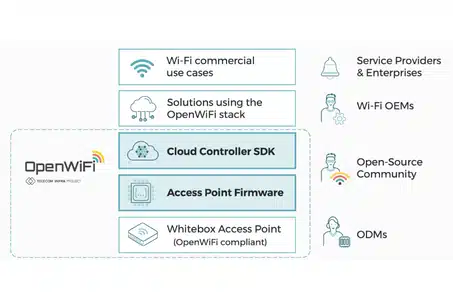
OpenLAN and OpenWiFi, developed under the Telecom Infra Project (TIP), provide a foundation for building open, interoperable WiFi networks.
They enable:
- Disaggregated hardware and software stacks
- Open control planes
- Standardized integration across devices
For operators, this means:
- Freedom to deploy hardware from multiple ODMs
- Consistent management across different environments
- Reduced dependency on proprietary ecosystems
Instead of being tied to a single vendor’s roadmap, operators can build networks that evolve based on their own requirements.
Control, Transparency, and Trust
As networks become more critical, three factors are emerging as non-negotiable:
Control
Operators must be able to configure, monitor, and evolve their networks without vendor-imposed limitations.
Transparency
Visibility into the network stack — from firmware to control plane — is essential for both performance and security.
Trust
Infrastructure must be auditable, predictable, and aligned with regulatory and operational requirements.
Open architectures directly address these needs.
By exposing interfaces, standardizing components, and enabling interoperability, OpenLAN allows operators to:
- Understand how their network behaves
- Verify configurations and updates
- Maintain oversight across the entire stack
From Vendor Choice to Stack Ownership
The most important shift is conceptual.
The key decision is no longer:
“Which vendor should I choose?”
It is now:
“How much control do I have over my infrastructure?”
In a traditional model, vendors control:
- Firmware
- Management systems
- Feature evolution
In an open model, operators regain control:
- Over how devices are managed
- Over how networks evolve
- Over how infrastructure adapts to change
This shift from vendor selection to stack ownership is defining the next generation
of WiFi infrastructure.
Adapting to Change: Real-World Impact for ISPs and ODMs
Adapting WiFi Deployments with OpenLAN (ISP Perspective)
For ISPs, the transition to open architectures is not theoretical — it directly impacts how networks are deployed and operated.
Consider a regional ISP delivering residential WiFi services.
In a traditional deployment:
- The ISP relies on a single vendor for hardware, firmware, and management
- The network is tightly coupled to that vendor’s ecosystem
- Any disruption — regulatory or supply chain — requires major redesign With an OpenLAN-based architecture, the model changes.
The ISP can:
- Deploy hardware from multiple ODMs
- Use a standardized, open software stack
- Maintain a consistent cloud control layer across devices
This leads to tangible benefits:
Flexibility in hardware sourcing
Devices can be replaced or diversified without impacting the overall system
Stability of the control plane
Management remains consistent even as hardware evolves
Faster adaptation to regulatory changes
Infrastructure can be adjusted without large-scale migrations
In this model, adaptability is built into the architecture — not added as a workaround.
Why ODMs Should Care
For ODMs, the shift toward OpenLAN represents a fundamental change in how value is created.
Traditionally, ODMs have been:
- Closely tied to specific vendors
- Dependent on proprietary software stacks
- Limited to narrow distribution channels
This model constrains innovation and exposes ODMs to risks tied to vendor-specific ecosystems.
In an OpenLAN-driven environment, the opportunity expands.
ODMs can:
- Develop standardized, interoperable hardware
- Integrate with multiple operators and platforms
- Reuse hardware designs across different deployments
This results in:
- Reduced dependency on a single vendor
- Access to a broader market
- Faster time to market across regions and operators
- Greater resilience to regulatory and supply chain changes
More importantly, ODMs move from being:
Hardware suppliers
to becoming:
Active participants in an open ecosystem
Where hardware innovation can be leveraged across multiple layers of the network stack.
Extending OpenLAN with MangoCloud
At Router Architects, we believe the shift toward open, controllable WiFi infrastructure is not just inevitable — it is already underway.
As part of this direction, we have initiated MangoCloud — an OpenLAN-aligned opensource cloud platform designed to support real-world deployments.
MangoCloud focuses on:
- Enabling operator and subscriber management layers
- Supporting residential WiFi use cases
- Providing a scalable, cloud-driven control plane
Rather than replacing existing components, the goal is to:
Build on OpenLAN and extend the ecosystem for practical, large-scale deployments.
This aligns with a broader vision:
- Networks that are operator-controlled
- Infrastructure that is transparent and auditable
- Architectures that are flexible and resilient
Conclusion
The future of WiFi infrastructure will not be defined by hardware alone.
It will be defined by:
- Who controls the network
- How transparent the system is
- How quickly infrastructure can adapt to change
The FCC ruling is not just a regulatory event — it is a signal of a deeper transformation. As the industry moves toward open, disaggregated architectures, initiatives like OpenLAN are laying the foundation for a new model of networking.
One where control, flexibility, and trust are built into the system — not added after the fact.
And for operators and ODMs alike, the question is no longer whether this shift will happen.
It is:
How quickly they can adapt to it.